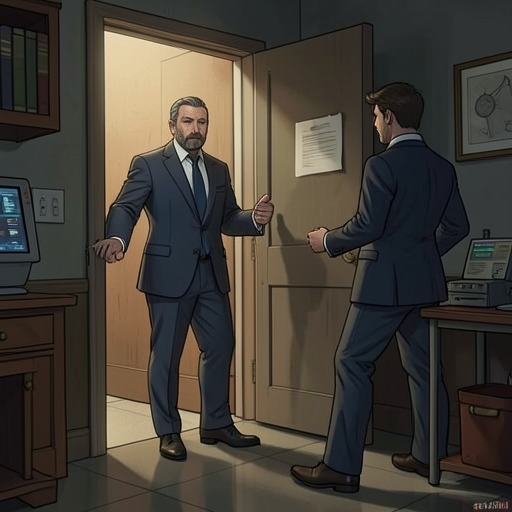
Don Challenor and Rex Challenor
Panic RoomDon Challenor’s bond with his father, Rex Challenor, survives in two sharply contrasting forms: the familiar memory of travelling together in Rex’s MGB, and Don’s later discovery that Rex had died alone. The car becomes a material link to childhood and a way of holding on to what Don knows and loves; the circumstances of Rex’s death, by contrast, remain a painful memory that can surface without warning.
The car and an inherited attachment
The clearest account of their time together comes through Don’s memory of riding as a child with Rex at the wheel of a 1973 MGB GT V8. Years later, Don still refuses to trade the car for a newer or more economical model. Its leather interior and engine rumble are familiar to him from those childhood journeys, making his attachment more than a matter of motoring preference. The MGB carries a history shared with his father into Don’s adult life.
Other people regard Don’s insistence on keeping the car as environmentally irresponsible and as an attempt to recapture lost youth. The narration acknowledges those judgments but locates Don’s reason elsewhere: he is cleaving to what he knows and loves. That explanation gives the car a relational weight without suggesting that it represents the whole of their relationship. What the evidence makes visible is a specific inheritance of sensation and habit: a vehicle once driven by Rex, now kept and driven by Don.
Rex’s death and Don’s shock
In 1995, a neighbour summoned Don to Rex’s flat in Honor Oak after raising concerns about the property. Don had a spare key, and he believed he already knew what awaited him: Rex had been declining after failed business ventures, drinking, and the sense that his luck would not change. Don expected to find his father dead, but that expectation did not prepare him for the reality of a death that had gone undiscovered for several days.
Don later identifies the cause as alcoholic poisoning and confirms that Rex was not found for days. The account establishes the painful circumstances of Rex’s death without presenting it as a simple resolution to their relationship. Don’s foreknowledge and practical readiness to enter the flat coexist with the shock of what he encountered. Knowing that death was likely did not mean he was prepared to face it.
Memory returning in the present
The memory does not remain safely confined to the past. After a poor night at Wortalleth West, Don dreams of his father and of himself as a child walking in the countryside. Patch, the family dog who had arrived when Don was five, is with them, though in the dream the dog is already fully grown. Patch runs into the woods; Don follows but cannot find him. The dream offers a brief scene of father and son together, then turns on a disappearance Don cannot undo within it.
When Don wakes, his wrist is severely painful. The morning continues through small, practical difficulties: he struggles to wash and shave, cuts himself, and later spills most of his coffee after instinctively reaching for the cup with his right hand. The passage then moves abruptly into his memory of Rex’s death. The transition makes the past feel less like a story Don has chosen to tell than an experience unexpectedly brought back into the present. The narration describes Don as someone usually able to manage his memories, but this time he is caught out by them.
Blake finds him in that unsettled state and asks whether he is all right. Later, when Maris asks what has been troubling him, Don says it is his father and how he died. He answers her question about the death directly, giving the cause and the delay before Rex was found. These exchanges show Don making the memory speakable to others, even as the earlier scene has shown how involuntary its return can be.
What the relationship leaves behind
The evidence presents the relationship through recollection rather than a full account of family life. It establishes Rex as the father at the wheel during Don’s childhood, the man whose MGB remains bound to Don’s sense of familiarity, and the father whose death became one of Don’s most difficult memories. It does not supply enough detail to characterize the whole of their history together, so the significance lies in these concrete traces rather than in an unsupported account of their day-to-day intimacy.
The contrast between the MGB and the memory of the flat is central. One is a durable object Don continues to choose; the other is an episode he does not control when it returns. Together, they show how Rex remains present in Don’s adult life both through an attachment he consciously preserves and through grief that can interrupt the ordinary demands of the morning. His father’s place in Don’s story is therefore neither reduced to the car nor exhausted by the manner of his death: the bond is conveyed through the persistence of both.